
How to Read a Greyhound Racecard: Every Symbol Decoded
 Available in US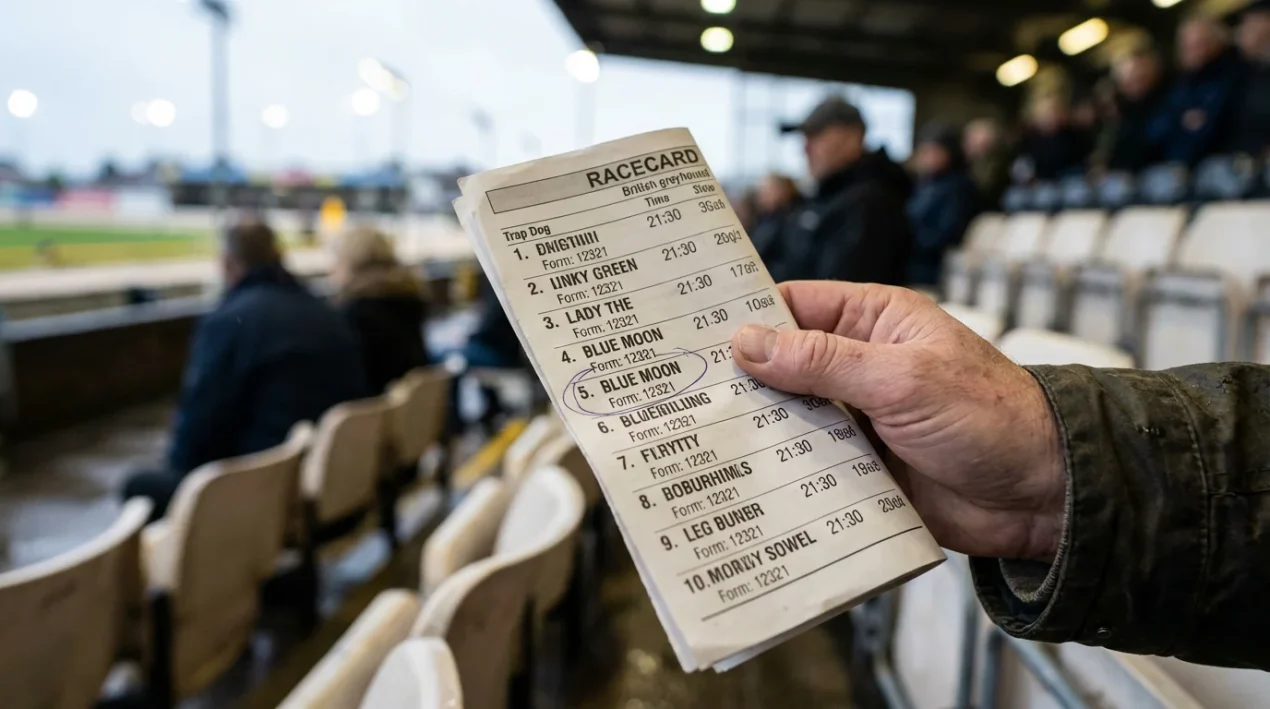
Contents
The Densest Data Sheet in Racing
A greyhound racecard compresses everything the punter needs to know into a small block of text and numbers. Each dog gets a few lines containing trap number, recent form, finishing times, sectional splits, weight, trainer name, and race comments. For the uninitiated, the racecard looks like alphabet soup. For the trained eye, it tells a story about what happened and what might happen next. Get more form guides at greyhoundbettingstrat.
Learning to read a racecard is not optional for serious greyhound bettors. Without this skill, you are betting on names and prices rather than substance. Every competent punter in the market reads the same information; your edge comes from reading it more carefully, more critically, or more creatively than they do.
Racecards from different sources present information in slightly different formats. The Racing Post, track websites, and betting platforms each have their own layouts. The underlying data is the same, but the arrangement varies. Once you understand what each element means, adapting to different formats becomes straightforward.
What follows is a systematic breakdown of racecard components. Work through it with a racecard open on another screen. The examples will make more sense when you can see real data rather than abstract descriptions.
Trap Numbers and Racing Colours
Every greyhound in a UK race wears a coloured jacket corresponding to its trap number. The colours are standardised and universal: Trap 1 wears red, Trap 2 blue, Trap 3 white, Trap 4 black, Trap 5 orange, and Trap 6 black and white stripes. Learning these colours is essential for following live racing, whether at the track or on screens.
The trap number tells you where the dog starts relative to the inside rail. Trap 1 sits closest to the inside; Trap 6 sits on the outside. For a race run in an anticlockwise direction — the standard UK configuration — inside traps have a shorter route to the first bend, while outside traps must cover more ground or risk crowding.
Trap position interacts with running style. A railer naturally hugs the inside, so Trap 1 or 2 suits this type. A wide runner comfortable on the outside will not mind Trap 5 or 6. The racecard shows you the trap draw; your job is to assess whether that draw helps or hinders each dog’s preferred racing pattern.
Seeding determines trap allocation. The grading secretary at each track assigns traps based on running style, aiming to separate dogs that might interfere with each other early in the race. The seeding system is imperfect and is itself a factor to consider: a railer forced wide by seeding faces a different challenge than a railer drawn ideally.
Reserve runners add complexity. If a dog is withdrawn before the race, a reserve may take its place — but the reserve enters in a different trap than originally scheduled. This reshuffles the race dynamics, sometimes significantly. Check for late withdrawals and reserve insertions before concluding your analysis.
Decoding Form Figures
Form figures appear as a string of numbers, typically showing the dog’s finishing position in its last six races. A form line reading 312451 means the dog finished third, first, second, fourth, fifth, then first in its six most recent outings. Recent results appear on the right; older results sit on the left. The rightmost figure is the last run.
A hyphen or dash indicates a break in racing — the dog did not run for a period. The letter W denotes a win. Some formats show additional characters: F for a fall, T for a trap hit at the start, or S for slipping on the first bend. These letters describe incidents that affected the result and require attention.
Numbers alone tell you the result, not the story. A dog that finished fourth might have been beaten four lengths or beaten a nose. It might have led until the final stride or never featured at any point. The form figures are a starting point, not a conclusion. Everything else on the racecard and in the replays fills in the missing context.
Grade information accompanies form figures. You might see A4 or A7 next to a result, indicating the grade of race in which that result was achieved. A dog winning in A7 company and now running in A4 faces stiffer opposition. Grade changes are essential context: a string of wins at lower grades does not guarantee competitiveness at a higher level.
Distance matters alongside grade. A dog running over 480 metres today might have recent form over 280 metres. The figures transfer only loosely — a confirmed sprinter may struggle at middle distances, and vice versa. Check that recent form is relevant to the race conditions in front of you.
Track codes identify where each run took place. A dog running at Romford tonight might show recent form from Crayford, Monmore, and Nottingham. Form at unfamiliar tracks is less reliable as a guide than form at the track where today’s race takes place. Home-track specialists deserve extra credit; visiting dogs deserve extra scrutiny.
Times, Comments, and What They Hide
Finishing time appears in seconds and hundredths, showing how long the dog took to complete the race. A time of 28.42 over 480 metres is fast; 29.15 over the same distance is modest. Times allow direct comparison between dogs running the same distance at the same track, but they do not transfer across tracks or distances without adjustment.
Sectional times break the race into segments, typically showing the split at the first bend and the overall finishing time. A dog that records a fast first split but a slower overall time is running from the front but fading late. A dog with a slow first split but a fast overall time is finishing strongly from behind. These patterns indicate running style and help predict how the dog will race today.
Calculated times attempt to standardise performances across different conditions. Some racecards show a calculated or adjusted time that accounts for track conditions, grade of race, and other factors. These figures are useful for comparison but rely on methodologies that are not transparent to the punter. Treat them as additional information rather than ground truth.
Race comments describe what happened during the run. Common phrases include led from start, challenged entering straight, stumbled first bend, crowded early, ran on well, and faded from three out. These comments explain results that the finishing position alone cannot. A dog that led and faded might have been unsuited by a fast early pace; one that ran on well from behind might be ready to lead if it gets a clear run this time.
Comments are written by observers and carry subjective judgment. Two different observers might describe the same race differently. When possible, watch the replay to verify whether the comment matches what you see. A comment claiming crowded early means little if the replay shows the dog ran freely — and vice versa.
Weight is listed in kilograms, usually to one decimal place. Greyhounds fluctuate in weight from race to race; significant changes may indicate issues with fitness or condition. A dog that has gained a full kilogram since its last run deserves investigation — it may be coming back from a break, or it may be losing racing condition.
Reading Between the Lines
The racecard provides data. It does not provide interpretation. Two punters looking at the same racecard will draw different conclusions based on how they weight each piece of information and what additional context they bring. The form figures mean nothing without understanding why those results occurred; the times mean nothing without knowing what conditions produced them.
Build a systematic approach to reading cards. Some punters start with trap draw, then check form, then verify with comments. Others start with times and work backward. The sequence matters less than consistency: process the same information in the same order every time, and you will develop speed and accuracy through repetition.
Do not rely on the racecard alone. Watch replays of recent runs. Cross-reference trainer form across your focus tracks. Note how each dog responds to different conditions and different competition levels. The racecard is the foundation; everything else you learn builds on top of it. Also explore our reading form guide.
A well-read racecard tells you which dogs can win, which dogs should be opposed, and which races are too difficult to read confidently. That last category is as important as the first two. Some races present six plausible winners with no clear separation; those races are best left alone. The racecard, properly understood, protects you from bad bets as much as it identifies good ones.
