
Dutching Greyhounds: Backing Multiple Dogs for Profit
 Available in US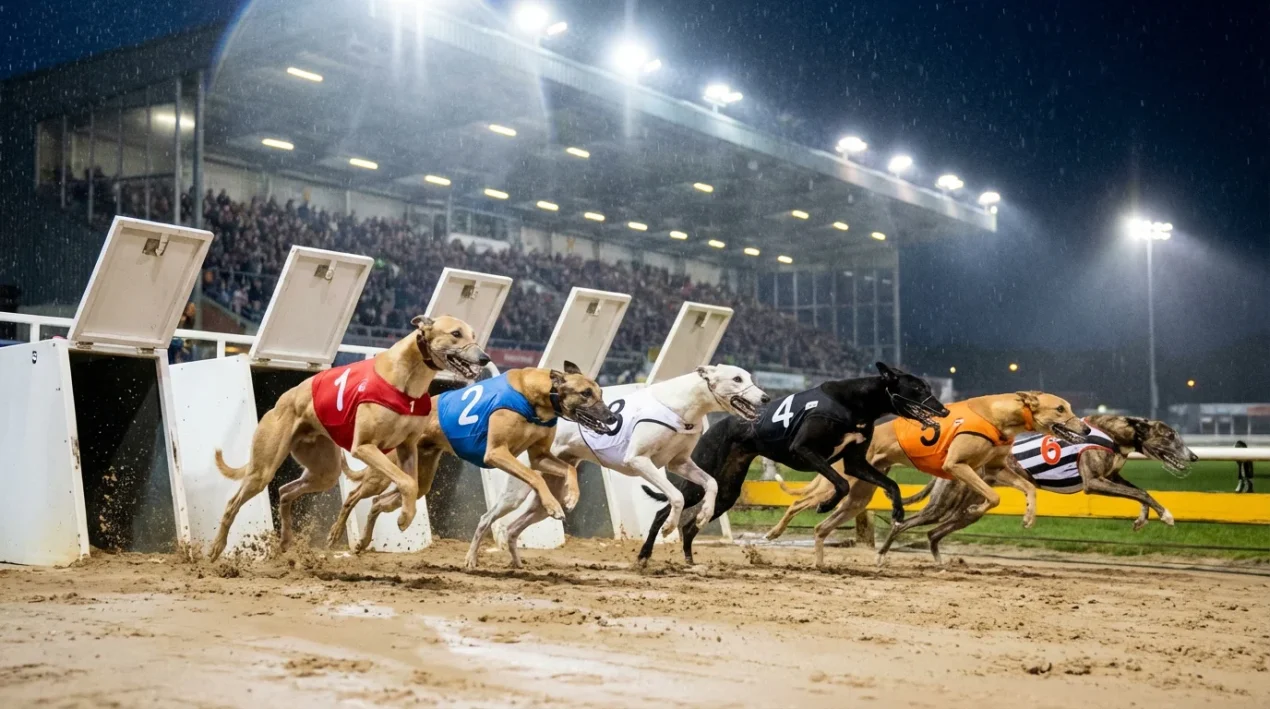
Contents
Why Back One Dog When Two Can Pay?
The classic betting question assumes a single answer: which dog wins? Dutching asks a different question entirely. It asks: which dogs should I back together to guarantee a profit regardless of which one crosses the line first? Find more strategy guides at greyhoundbettingstrat.
In a six-dog greyhound race, Dutching makes particular sense. The field is small enough that backing two or three selections still leaves meaningful profit margins, yet large enough that competitive races regularly produce overlapping value. When two dogs both look plausible winners at prices that add up to more than fair value, the punter who backs just one is making an unnecessary choice.
Dutching is not a staking system in the recovery sense. It does not help you recoup losses or chase a target. What it does is distribute your stake across multiple selections so that the return is identical whichever of your chosen dogs wins. The mechanic is simple: you calculate the proportion of the total stake to place on each selection based on its odds. The strategy is where things get interesting.
British bookmakers are familiar with Dutching, and many punters assume it has been priced out of usefulness. That assumption is wrong. In greyhound racing, where six-dog fields create concentrated betting markets and late money can shift prices rapidly, Dutching opportunities appear more frequently than in larger-field sports. The key is knowing when to deploy it and when to walk away.
The Mathematics of Dutching
Dutching requires converting odds into implied probabilities, then working backwards to calculate the stake required on each selection to produce an equal return. The formula is not complicated, but it punishes sloppiness. Get the maths wrong and you lock in a loss rather than a guaranteed profit.
Start with implied probability. A dog at 3/1 has an implied probability of 25%. At 4/1, it drops to 20%. At evens, it sits at 50%. The formula is simple: divide 1 by the decimal odds (or, for fractional odds, divide 1 by the sum of numerator plus denominator over denominator). A 3/1 shot in decimal terms is 4.0, so 1 divided by 4 equals 0.25, or 25%.
To Dutch two selections, add their implied probabilities. If Dog A is 3/1 (25%) and Dog B is 4/1 (20%), the combined implied probability is 45%. If that number stays below 100%, you have a theoretical profit margin. In this case, the market is giving you 45% implied chance for two selections, meaning a 55% margin on the other four dogs that you are ignoring. The lower the combined percentage, the greater the potential profit.
Now calculate the stake split. Divide each selection’s implied probability by the total of all your selections’ probabilities. For Dog A: 25 divided by 45 equals 55.6%. For Dog B: 20 divided by 45 equals 44.4%. If your total stake is ten pounds, you place five pounds fifty-six pence on Dog A and four pounds forty-four pence on Dog B. Whichever wins, you collect approximately the same return.
In practice, you will rarely hit exact parity due to rounding and the limitations of minimum bet increments. Most punters round to the nearest ten pence and accept a slight variance between outcomes. What matters is that both returns are positive and roughly equivalent, not that they match to the penny.
Online Dutch calculators handle this instantly. You enter the odds for each selection, input your total stake, and receive the breakdown. But understanding the underlying maths matters because it helps you spot opportunities faster and recognise when a Dutching situation is marginal rather than compelling.
When Dutching Makes Sense
Dutching is not a universal solution. It works best under specific conditions, and applying it indiscriminately turns a useful strategy into a grind against the margin.
The ideal Dutching race has no clear favourite. When the market shows a 4/6 shot with four double-figure prices behind it, the race is not competitive in Dutching terms. The favourite’s short price makes it difficult to construct a profitable Dutch that includes it, and excluding it means backing longshots against a dog the market strongly fancies. Competitive races — those where the top two or three in the betting are separated by a point or two — offer far better Dutching terrain.
Look for races where your own form analysis identifies multiple plausible winners. Perhaps two dogs have favourable trap draws for their running styles. Perhaps one dog is dropping in grade after an unlucky run while another has strong sectional times at this distance. When your assessment suggests genuine uncertainty about the winner within a small group, Dutching captures that uncertainty profitably.
Trap dynamics create Dutching opportunities that form alone might miss. A race with two confirmed railers drawn in Traps 1 and 2 might produce early crowding, but whichever emerges first has a strong chance to win. Dutching both captures that scenario without requiring you to predict which railer breaks sharper.
Weather and track conditions amplify Dutching logic. On a wet night, inside traps may gain an advantage across multiple races. If two dogs look well suited to wet conditions and both have favourable trap draws, Dutching them together bets on the condition rather than demanding you separate two similar profiles.
Avoid Dutching in races with a dominant favourite that you have no reason to oppose. If the market prices a dog at 4/7 and your form assessment agrees, Dutching two outsiders against it is not clever positioning — it is a donation to the bookmaker. The strategy assumes competitive races with genuine outcome uncertainty, not wishful opposition to short-priced dogs.
Similarly, avoid Dutching too many selections. Covering three dogs can still work in a six-dog field, but covering four or five eliminates your profit margin entirely. The point is selective multi-selection betting, not blanket coverage.
Dutching in Practice: Worked Examples
Consider a Tuesday evening race at Monmore. The market shows: Trap 1 at 5/2, Trap 2 at 3/1, Trap 3 at 7/2, Trap 4 at 4/1, Trap 5 at 6/1, Trap 6 at 8/1. No dominant favourite, a genuine six-dog race. Your form work suggests Trap 1 and Trap 3 both have strong claims — Trap 1 is a proven railer with a perfect draw, Trap 3 has the best sectional times over this distance and drops a grade tonight.
Trap 1 at 5/2 converts to decimal 3.50, implied probability 28.6%. Trap 3 at 7/2 converts to decimal 4.50, implied probability 22.2%. Combined probability: 50.8%. You are covering half the race with a combined implied probability just over 50%, meaning the market still assigns roughly 50% to the other four dogs. This is workable.
With a twenty-pound total stake: Trap 1 receives 28.6 divided by 50.8, which equals 56.3% of the stake, or eleven pounds twenty-six pence. Trap 3 receives the remaining 43.7%, or eight pounds seventy-four pence. Round to eleven pounds thirty pence and eight pounds seventy pence for simplicity.
If Trap 1 wins at 5/2, your return is eleven pounds thirty pence times 3.50, which equals thirty-nine pounds fifty-five pence, for a profit of nineteen pounds fifty-five pence. If Trap 3 wins at 7/2, your return is eight pounds seventy pence times 4.50, which equals thirty-nine pounds fifteen pence, for a profit of nineteen pounds fifteen pence. Near-identical profits regardless of which selection lands.
Now consider a less favourable scenario. Same race, but you fancy Trap 1 at 5/2 and Trap 2 at 3/1. Implied probabilities: 28.6% and 25%, combined 53.6%. Still workable, but tighter. The returns will be slightly lower because your selections absorb more of the market probability, leaving less margin. Dutching works here, but the edge is thinner.
A third scenario: you want to Dutch the 4/6 favourite with a 5/1 outsider. The favourite’s implied probability is 60%, the outsider’s is 16.7%, combined 76.7%. You are now covering over three-quarters of the market probability with two selections, which demolishes your profit margin. The outsider would need to be much longer to make this Dutch worthwhile, and at that point, you might question why you are coupling a strong favourite with a rank outsider at all.
Dutching Works — Until You Forget Why
Dutching is a tool, not a philosophy. It solves a specific problem: what to do when your analysis points to multiple credible winners and you cannot separate them on form alone. It does not solve the problem of poor selection, and it does not turn marginal value into solid profit.
The danger is complacency. When Dutching feels easy, punters start applying it to races where one selection is clearly stronger, or where the combined implied probabilities creep too high. They Dutch four dogs in a six-runner race and wonder why the returns are so thin. They couple long-priced hopes with short-priced favourites and discover the maths works against them.
Discipline matters as much as calculation. Reserve Dutching for competitive races where your form work genuinely cannot separate two or three dogs. Keep your combined implied probability below sixty percent where possible, and well below fifty percent when you can find it. Accept that some races simply do not suit Dutching and require a single-selection approach or no bet at all. Also explore our staking systems guide.
When applied correctly, Dutching turns indecision into strategy. It transforms a race where you would otherwise flip a mental coin into a structured position that profits on multiple outcomes. That is its value. Respect the conditions that make it work, and it will reward you consistently.
