Greyhound Running Styles Explained: Rails, Middle and Wide
 Available in US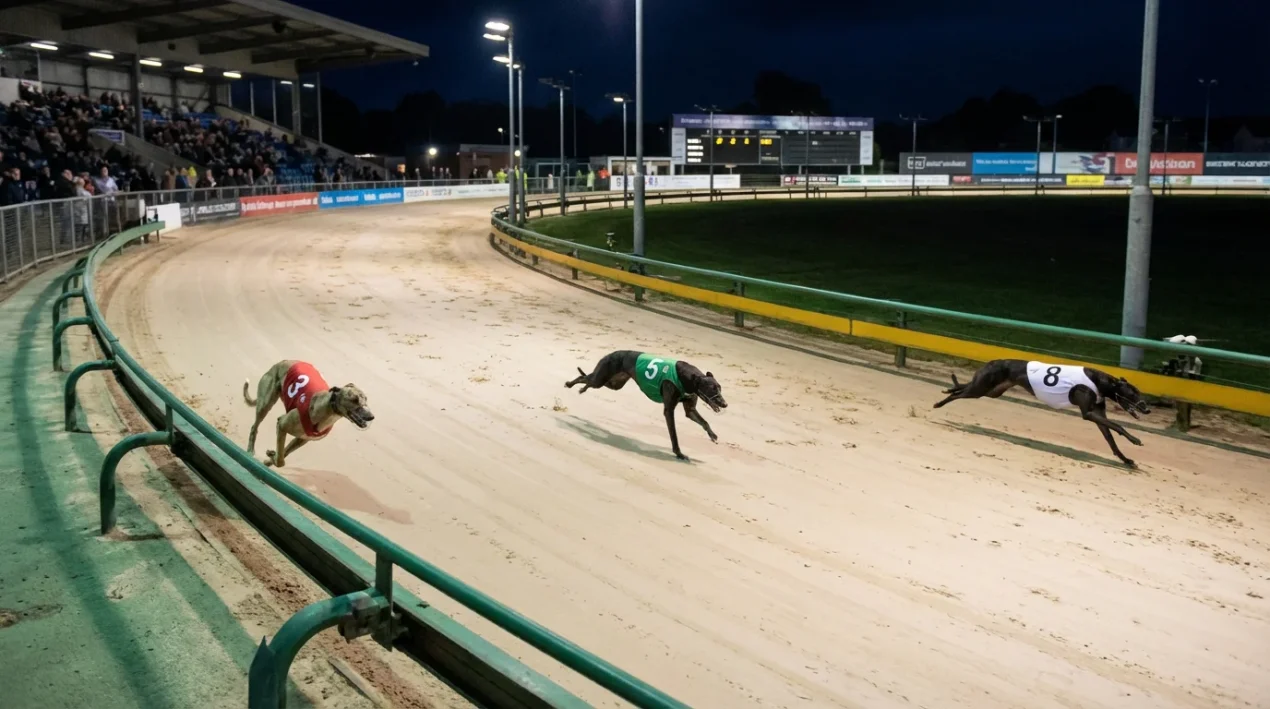
Contents
Every Dog Has a Lane Preference
A railer in Trap 6 is a problem — and the racecard won’t warn you. Every greyhound has a natural inclination for where it wants to run on the track. Some hug the inside rail from the moment the traps open. Others drift wide and use the extra space on the outside to build speed through the bends. A third group sits in the middle, navigating between the rail runners and the wide runners with varying degrees of success. Get more race analysis at greyhoundbettingstrat.
These preferences aren’t arbitrary. They’re ingrained running behaviours, shaped by physical build, early racing experience, and temperament. A big, powerful dog with a wide stride often runs best with space around it, while a smaller, lighter dog may gain an advantage by saving ground on the inside. The running style is noted on every UK racecard with shorthand markers — (rls) for a railer, (m) for a middle runner, and (w) for a wide runner — and understanding what those letters mean for race-day outcomes is one of the more reliable edges in greyhound form analysis.
The reason this matters for betting is simple: running style interacts directly with the trap draw. When a dog is placed in a trap that suits its natural running preference, it gets a cleaner run. When it isn’t, it has to cross other dogs’ paths to reach its preferred position, creating interference that costs lengths and sometimes races. Reading running styles and cross-referencing them with the trap draw is the fastest way to identify dogs that are better or worse than their odds suggest.
Rails Runners: Hugging the Inside
Railers save ground but need a clean break to the inside. A rail runner’s ideal race is straightforward: break sharply from Traps 1 or 2, reach the first bend in front or close to the leader on the inside line, and hold that position by staying tight to the rail for the rest of the race. The advantage is distance — the inside line is the shortest route around any oval track, and a dog that holds the rail from start to finish covers measurably less ground than one running wide.
The problem arises when a railer is drawn in Traps 4, 5, or 6. Now it has to cross one or more lanes to reach the inside, and it has to do so while five other dogs are also jostling for position heading into the first bend. The result is usually one of two things: either the railer gets across cleanly (possible but risky) or it gets checked, bumped, or blocked by dogs already occupying the inside path. Either way, the clean run it needs to perform at its best is compromised.
On the racecard, a railer drawn in Trap 1 at a tight track is close to an ideal racing setup. A railer drawn in Trap 5 or 6 at the same track is fighting its own instincts. The dog wants to go left; the race is pulling it right. That tension costs time, and time costs places. When you see a well-fancied railer drawn wide, it’s worth asking whether the market has fully accounted for the positional disadvantage. Often it hasn’t — and that’s an angle for opposing the favourite or looking elsewhere in the race.
Railers also tend to be more effective at tracks with tighter bends, where saving ground on the inside produces a more pronounced advantage. At wider circuits, the ground saved by hugging the rail is less significant, and the risk of getting caught in traffic on the inside can actually outweigh the benefit.
Middle and Wide Runners: The Outer Lane Advantage
Wide runners need space — and some tracks give it while others don’t. Middle runners (typically seeded into Traps 3 and 4) occupy the least dramatic position on the track. They don’t save as much ground as railers, but they also face less crowding on the bends. In practice, middle runners are the most versatile category. They can adjust their line inward or outward depending on how the race unfolds, which makes them slightly more resilient to unfavourable draws than pure railers or wide runners.
Wide runners (Traps 5 and 6 ideally) are a different proposition entirely. These dogs naturally sweep to the outside through the bends, covering more ground but doing so in open space. The trade-off is distance for freedom — a wide runner rarely gets interfered with through the turns, but it needs to be fast enough to compensate for the extra metres it covers on every bend. Over a four-bend sprint race, a wide runner might cover three to five metres more than a railer. At the margins of competitive graded racing, that’s a significant disadvantage unless the dog has the raw speed to absorb it.
The conditions under which wide runners thrive are specific and worth noting. Larger-circumference tracks with more gradual bends reduce the distance penalty. Wet weather can also help wide runners: when rain makes the inside rail heavy and slow, the firmer ground on the outer part of the track becomes the faster line. A dog marked (w) on the racecard might be a poor proposition on a dry Tuesday at Crayford but a genuinely strong bet on a wet Saturday at Nottingham.
Middle runners, being more neutral in their track preferences, are generally less affected by trap draws. A middle runner in Trap 2 or Trap 5 isn’t in its ideal spot but can usually adjust without major interference. This flexibility makes them less exciting from a bias-exploitation standpoint, but it also makes their form figures more reliable across different draws — useful information when assessing consistency.
How Running Style Meets Trap Draw
Predict the first bend and you’ve predicted half the race. The seeding system at UK greyhound tracks is designed to minimise clashes by placing rail runners in inside traps, middle runners in the centre, and wide runners on the outside. In graded races — the bread and butter of everyday UK racing — the racing office does a reasonable job of matching style to trap. But it’s not always possible, particularly in open races where the field is assembled from dogs at different tracks, or when there simply aren’t two railers, two middle runners, and two wide runners available for a six-dog field.
When the seeding breaks down, the race shape becomes much harder to predict — and that unpredictability creates both danger and opportunity for bettors. Consider a race where four of the six dogs are railers. Traps 1 and 2 will each have a natural railer, but Traps 3 and 4 will also contain dogs that instinctively want to cut inside through the first bend. The result is congestion on the rail, bumping through the turn, and a race that’s likely decided by which dog avoids the chaos rather than which dog is fastest.
In that scenario, the wide runner in Trap 6 — even if it’s not the most talented dog in the field — suddenly has a structural advantage. It breaks cleanly on the outside, avoids the first-bend pile-up, and runs its own race while the railers are checking each other. This is the essence of race-shape analysis: not who’s fastest in isolation, but who’s best positioned given the collective running styles of the entire field.
To apply this practically, scan the racecard before every race you’re considering. Note the running style of each dog and its trap draw. Look for mismatches — railers in wide traps, wide runners in inside traps. Then look for dogs whose natural style aligns perfectly with their draw. Those aligned dogs have one fewer obstacle between themselves and a clean run. In a sport where fractions of a second separate winners from also-rans, that alignment can be the decisive factor.
The market often underestimates running-style conflicts. A dog might be the form pick of the race, but if it’s a confirmed railer drawn in Trap 5 alongside two other railers in Traps 3 and 4, its chance of a clean run drops substantially. Learning to identify these conflicts — and to bet accordingly — separates the analytical punter from the one who just backs the dog with the best time.
It’s also worth combining this analysis with trap bias data. If a track shows a strong inside-trap advantage and the only non-railer in the field is drawn in Trap 6, you’re looking at a race where the bias and the running-style dynamics point in the same direction. When multiple factors align, the confidence in a selection — or the confidence in opposing a particular dog — increases proportionally.
Style Tells You Where — Form Tells You Whether
Knowing a dog’s preferred lane is step one — knowing what it does when it gets there is step two. Running style is a filter, not a verdict. It tells you which dogs are well drawn and which are fighting their own natural inclinations. It helps you anticipate the race shape before the traps open. But it doesn’t tell you whether a particular dog is actually fast enough, fit enough, or motivated enough to win.
That’s where form reading comes in. The most productive approach is to use running style as the first stage of analysis — eliminating or downgrading dogs with style-trap mismatches — and then applying form assessment to the remaining contenders. A dog that’s well drawn for its running style and shows improving recent form is a fundamentally stronger proposition than one that has the form but not the draw, or the draw but not the form. Also read our greyhound trap bias guide.
In the long run, the punters who consistently account for running styles in their selections don’t just find more winners. They avoid more losers. And in greyhound betting, where the margins between profit and loss are measured in small fractions of percentage points over hundreds of bets, the ability to systematically exclude bad bets is worth at least as much as the ability to find good ones.
