
Greyhound Trap Bias: How Starting Position Shapes Results
 Available in US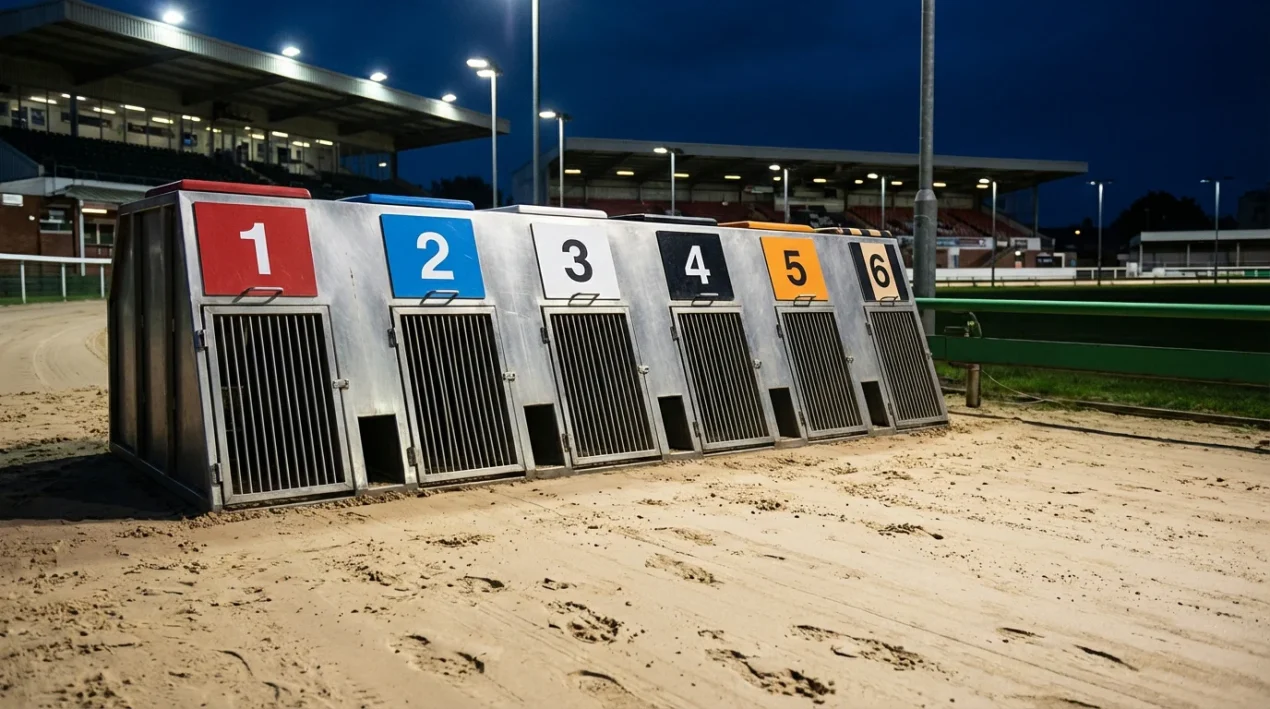
Contents
Trap Bias Isn’t a Myth — It’s Maths
If every trap won equally often, there’d be no angle — but they don’t. UK greyhound racing sends six dogs from six traps in every race, which means the expected win rate for each starting position is precisely 16.67%. A coin-flip world. Except the data tells a different story, and it has done so consistently for decades. Get more race analysis at greyhoundbettingstrat.
Trap bias refers to the measurable tendency of certain starting positions to produce winners at a rate significantly above or below that theoretical baseline. At some tracks, Trap 1 wins twenty percent of graded races. At others, the outside boxes outperform the inside by several percentage points across hundreds of races in a calendar year. These deviations aren’t flukes. They’re structural — driven by track geometry, surface conditions, and the physics of how six dogs navigate a shared oval at close to forty miles per hour.
For punters, trap bias represents one of the more straightforward analytical edges in greyhound racing. You don’t need to decode sectional times or study trainer patterns. You need a table of numbers and the discipline to apply them selectively. The trap data is publicly available, it updates with every meeting, and it rewards anyone willing to look past the racecard and into the stadium’s physical design. The catch, as always, is knowing when the data is signal and when it’s noise.
UK Trap Bias Data by Track
The numbers don’t lie — some traps consistently outperform. Below is a representative snapshot of trap win percentages across major UK licensed greyhound stadiums, drawn from graded race results. These figures are rounded to the nearest whole number and reflect full calendar-year data. Individual meetings will vary, but aggregate patterns are remarkably persistent.
| Track | Trap 1 | Trap 2 | Trap 3 | Trap 4 | Trap 5 | Trap 6 |
|---|---|---|---|---|---|---|
| Towcester | 20% | 17% | 16% | 15% | 16% | 16% |
| Romford | 19% | 18% | 16% | 15% | 15% | 17% |
| Crayford | 19% | 17% | 17% | 15% | 15% | 17% |
| Monmore | 18% | 17% | 16% | 16% | 16% | 17% |
| Nottingham | 17% | 17% | 17% | 16% | 16% | 17% |
| Hove | 17% | 17% | 16% | 16% | 17% | 17% |
| Sheffield | 18% | 17% | 16% | 15% | 16% | 18% |
| Harlow | 16% | 15% | 15% | 16% | 17% | 21% |
A few things stand out immediately. Towcester’s Trap 1 consistently posts a win rate around 20% — roughly three percentage points above expected. That translates to an extra win every thirty races compared to a world where traps don’t matter. Over a full year of racing, that’s dozens of additional winners from a single box position. Harlow, by contrast, shows a pronounced outside-trap advantage, with Trap 6 winning at 21% — among the highest single-trap strike rates at any UK stadium.
Wider tracks like Nottingham and Hove tend to show flatter distributions. When dogs have room to manoeuvre into their preferred positions before the first bend, the starting box matters less. At tighter circuits — Crayford and Romford being the classic examples — the inside traps carry a persistent edge because there’s simply less time and space for a wide runner to cross over before crowding becomes a factor.
It’s worth noting that these percentages represent aggregate annual data and can fluctuate significantly within individual meetings. Weather shifts, track maintenance, and seasonal variations all introduce short-term deviations from the long-term pattern. More on the mechanics of why that happens below.
Methodology matters here. Always look at sample sizes before drawing conclusions. A trap striking at 25% over thirty races might be noise. A trap striking at 19% over five hundred races is almost certainly telling you something real. The Greyhound Board of Great Britain publishes race results through its licensed data partners, and several free stats sites aggregate this data by track and time period.
What Causes Trap Bias
Bias isn’t random — it’s built into the concrete and the weather. Three primary factors drive persistent trap-performance differentials at UK greyhound stadiums, and understanding them helps you predict when bias will be stronger, weaker, or temporarily reversed.
The first and most important factor is track geometry. UK greyhound tracks are ovals, but they’re far from identical. A tight circuit like Crayford has sharper bends and a shorter run to the first turn from the traps. Dogs drawn on the inside have less ground to cover and reach the bend first, which means less crowding and a cleaner racing line. On wider circuits like Nottingham, the bends are more gradual and the distance from trap to first bend is longer. Dogs have time to find their running line regardless of starting position, which flattens any inherent bias.
The second factor is weather. Rain changes the surface grip across the track unevenly. The inside rail, which gets more foot traffic from dogs naturally gravitating inward, can become waterlogged more quickly — but paradoxically, the compacted sand near the rail often drains faster or provides a firmer footing than the looser, less-used outer lanes. The net result is that heavy rain typically amplifies inner-trap advantages at most UK tracks. Keep an eye on the first two or three races after a downpour: if Traps 1 and 2 are winning disproportionately, you’re seeing a weather-driven bias spike in real time.
The third factor is race distance. Sprint races (typically 240 to 285 metres) involve fewer bends and a shorter run-in. The trap draw matters more because there’s less race to correct a poor starting position. Stayers races (630 metres and beyond) involve four or more bends, and the longer distance allows dogs with stamina and adaptability to overcome a poor draw. If you’re analysing trap bias data, always filter by distance category. A track’s overall trap statistics might look flat, but its sprint figures could show a sharp inside advantage that’s diluted by the more neutral stayers data.
How to Use Trap Bias in Your Betting
Bias gives you a statistical tailwind — but only if the market hasn’t already priced it in. The most common mistake punters make with trap bias data is treating it as a standalone system. Backing every Trap 1 runner at a track with a known inside advantage would, over time, produce a strike rate above the expected 16.67% — but that doesn’t automatically mean you’ll profit. If the betting market already knows about the bias (and it usually does), the odds on those Trap 1 runners will be shorter than they should be on pure form alone.
The profitable application of trap bias is as a confirming factor, not a primary selection method. Here’s how the process works in practice. You do your form analysis and identify a dog you fancy. You check the trap draw and find that the dog is drawn in a statistically favoured position at this particular track. That’s a green flag — your selection has the bias working in its favour. If the odds still look reasonable given the dog’s form and the race conditions, you have a bet. If the bias is the only thing going for the selection, you don’t.
The strongest application is in competitive races where the market has no clear favourite. When three or four dogs are priced between 3/1 and 5/1, the one drawn in the highest-bias trap has a measurable advantage that the market often fails to fully account for. In these spots, the bias can tip the balance between a marginal bet and a genuine value opportunity.
There’s also a defensive application: avoiding dogs drawn against the bias. A wide runner in Trap 6 at a track with a pronounced inside advantage is fighting the architecture. Even if the form says it should win, the trap data says it’s swimming upstream. Being willing to oppose well-fancied dogs on the basis of unfavourable bias is just as valuable as backing dogs that benefit from it. Knowing when not to bet is, as ever, the sharper edge.
The Data Changes — Keep Watching
Last year’s trap data is a starting point — not a final answer. Greyhound tracks aren’t static environments. Sand surfaces get resurfaced. Drainage systems are upgraded or deteriorate. Bend rails are adjusted. A track that showed a strong inside bias in 2024 might flatten out in 2026 after maintenance work, or it might swing further in the same direction after a particularly wet autumn.
The practical response is to treat your trap bias data as a rolling dataset, not a fixed reference sheet. Update your numbers at least quarterly. Pay attention to changes in race-by-race patterns at your chosen tracks, especially after extended breaks in racing or visible track maintenance. If the first three races of an evening meeting all produce winners from Traps 1 and 2, and the track has been rained on for two days, you’re watching a bias develop in real time. That information is worth more than any historical table. Also read our greyhound running styles guide.
Trap bias is one of the more transparent edges available to greyhound bettors precisely because it’s grounded in physics rather than opinion. The track is shaped a certain way. The weather does what it does. The numbers follow. Your job isn’t to predict the bias — it’s to observe it, measure it, and act on it before the market fully catches up. That window is narrow, but for the attentive punter, it opens at every meeting.
